
Programs
High School Summit
Designed for high school sophomores & juniors
3 to 4 day programs available
Sample skills: Defining Purpose, Perspective Seeking, Civic Mindedness, & Civic Engagement
College Conference
Designed for college freshmen, sophomores, or juniors
2 to 4 day programs available
Sample skills: Resilience, Conflict Resolution, Empowerment, & Change Strategy
Curriculum Design
Developed by a Curriculum Committee of educators and practitioners representing primary school, secondary school, higher education, user research, and corporate instructional design; the Altus Leadership curriculum seeks to accomplish one primary goal: to create positive transformational programs. In order to accomplish this goal, the committee leveraged, reviewed, discussed, and challenged multiple ways of learning – including transformative learning theory (Mezirow) – to develop a comprehensive curriculum design. That design, featured below, begins with a philosophy and six guiding principles.

Curriculum Philosophy
Our curriculum will seek to create positive transformational moments that strengthen each leader’s agency, while propelling forward their individual leadership journeys. These moments will require safe, supportive, and engaging spaces. Once created, these spaces will introduce participants to new ideas and perspectives, which, if successful, will eventually lead to a better understanding of themselves and their innate abilities to create a positive impact.

Curriculum Principles
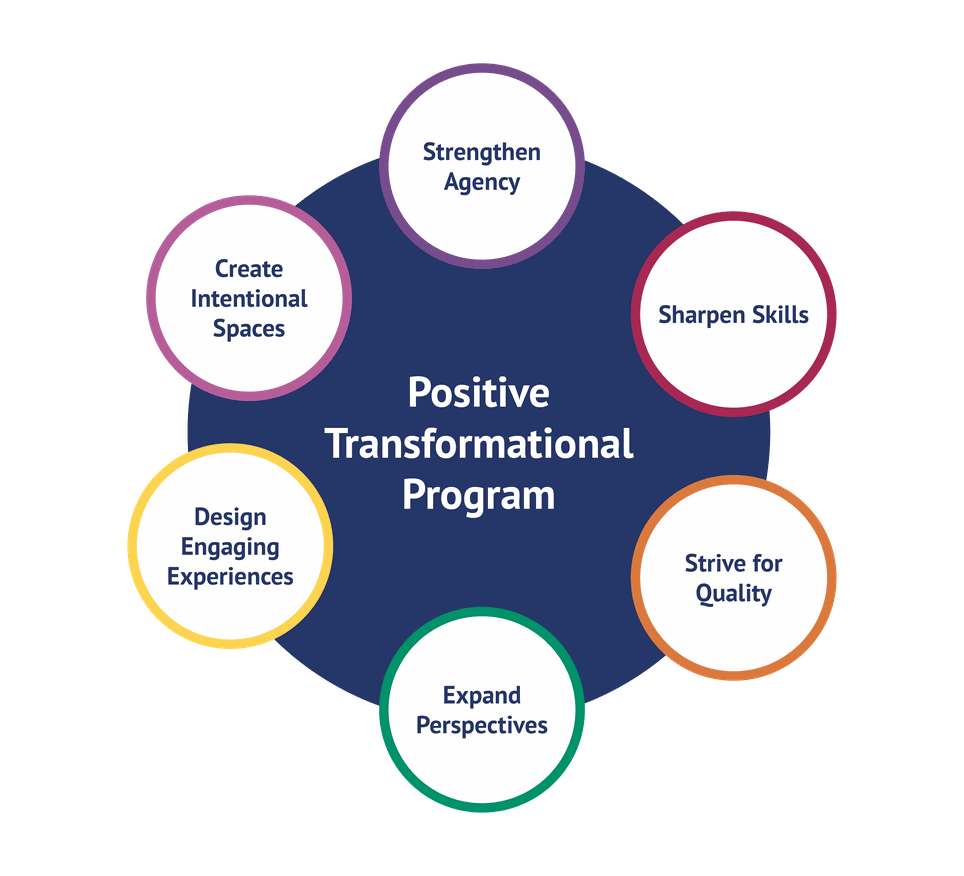
In tandem with our philosophy, Altus Leadership will leverage the following six guiding principles when developing and evaluating our programs: strive for quality, create intentional spaces, design engaging experiences, expand perspectives, strengthen agency, and sharpen skills. The success of every program will be measured against these principles, in a continuous cycle, to ensure our programs deliver upon their promise to elevate every leader’s journey.
Curriculum Modules & Skills
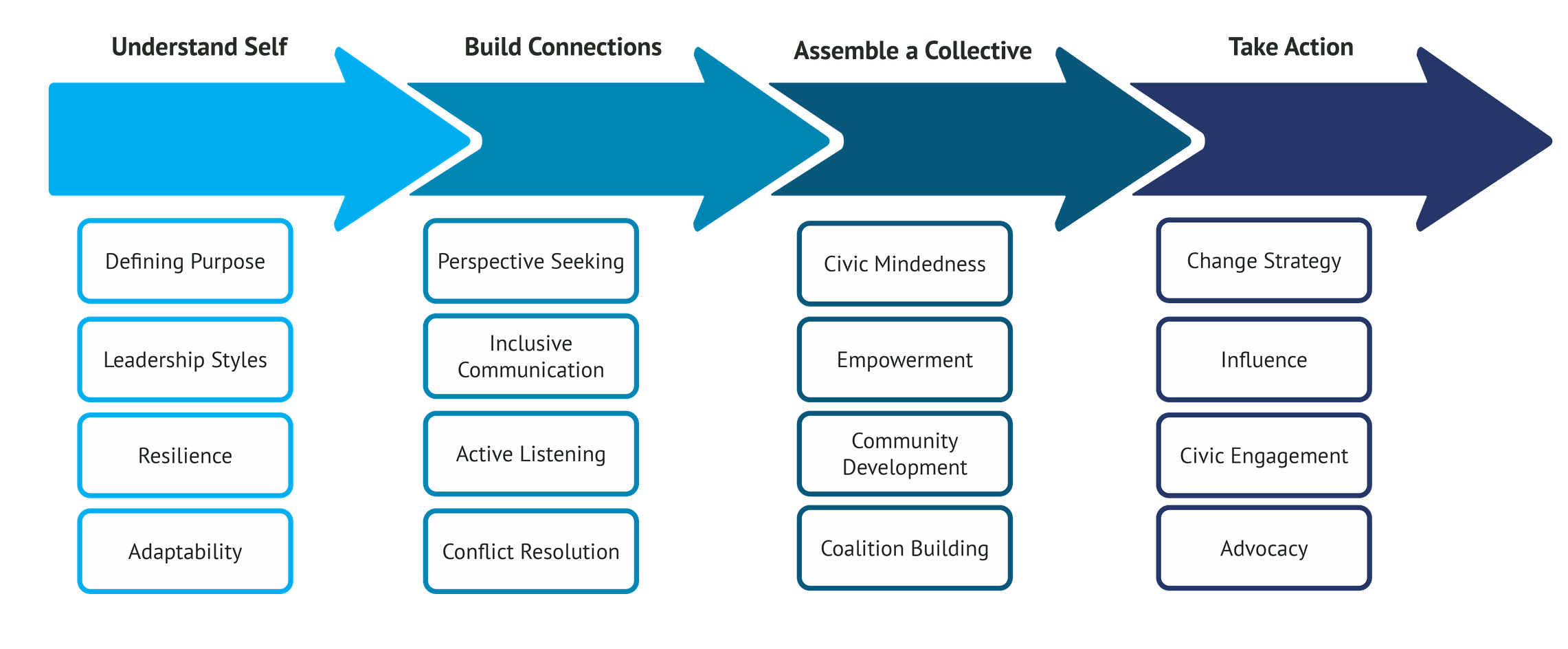
In addition to developing a curriculum philosophy and a set of six principles to guide the work of Altus Leadership, the Curriculum Committee developed a learning framework for each program. The framework outlines four learning modules: understanding self, building connections, assembling a collective, and taking action, which then pair with a collection of interchangeable, yet critically needed, skills. Take, for instance, the example graphic below. While every Altus program will include four modules, the skills learned in those modules can change depending on the nature of the program (high school or college) or the community’s identified needs.
High School Summit Sample Program

For an upcoming high school program, Altus Leadership could teach Defining Purpose, Perspective Seeking, Civic Mindedness, & Civic Engagement. Learning for each skill would occur over multiple hours of activities, group discussions, and reflection exercises. The intended outcome will be that participants not only enjoy a positive and transformational experience, but that they walk away from each program with real, actionable skill sets.
College Conference Sample Program

Additionally, skills can be interchanged when needed for college programs. As shown in the graphic above, an upcoming college program could instead teach Resilience, Conflict Resolution, Empowerment, and Change Strategy. While these skills aren’t inherently better than those taught at the high school level, they offer a more appropriate skill set for college students. Additionally, activities and discussions will be modified to better suit college participants. Not only in terms of academic rigor, but also in terms of maturity, content, and consideration.
Curriculum Learning Objectives
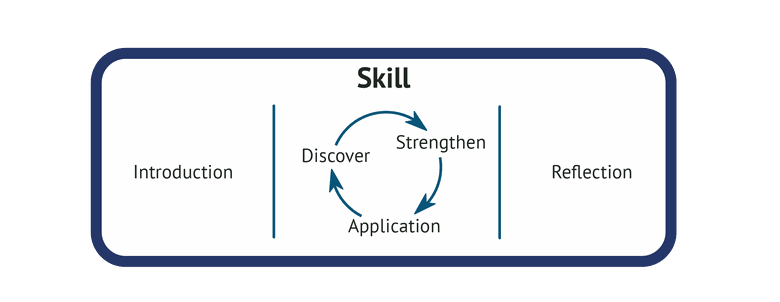
In their penultimate act, the Curriculum Committee discussed how each skill and module would function as a learning pathway or objective. The graphic shown on the right details their final iteration. The pathway will begin with an introduction, will close with a reflective task or activity, and in between these two elements, participants will engage in activities that either help them discover, strengthen, or apply that skill. The order in which these steps occur will vary from activity to activity, and skill to skill. However, every module and skill will include an activity to help them learn more (discover), elevate their current knowledge (strengthen), or practice their understanding (application).

The Summit program will be designed for high school sophomores and juniors and will typically last 3 to 4 days. Students representing schools from across Washington State will be organized into groups of 7 to 10 and will be guided through their Altus experience with at least one trained adult volunteer.
While not yet finalized given our current market research efforts, the following graphic outlines the type of skill set each participant will walk away with once they complete their Summit program. Skills: Defining Purpose, Perspective Seeking, Civic Mindedness, & Civic Engagement.
If you’d like to volunteer for an inaugural Summit program, or if you’d like to nominate a future participant, please contact us today!
The Conference program will be designed for college freshmen, sophomores, and juniors, and will typically last 2 to 4 days. In partnership with a higher education institution, students will be selected from that institution and referred to Altus Leadership for the Conference. Once selected, students will be organized into groups of 6-8 and will be guided through their Altus experience with at least two trained volunteers.
While not yet finalized given our current market research efforts, the following graphic outlines the type of skill set each participant will walk away with once they complete their Conference program. Skills: Resilience, Conflict Resolution, Empowerment, and Change Strategy.
If you’d like to volunteer for our inaugural Conference program, or if you’d like to recommend your school for an Altus program, please contact us today!
